Follow us:

Products

Hotline
Download

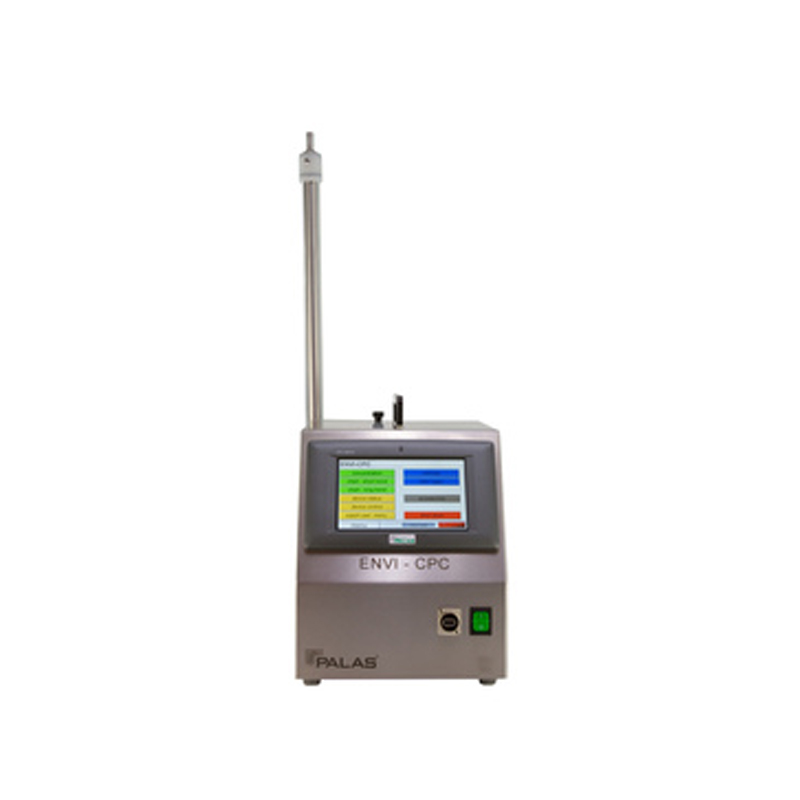
ENVI-CPC 200

Nanoparticle counter for ambient air monitoring with Nafion® aerosol dryer (optional) and high volume flow for up to 2 • 106 particles/cm3 (single count mode)

    The unique, patented way of providing the working fluid for unattended operation of months
    Depending on the sensor used (exchangeable by the user), the ENVI-CPC counts up to 2,000,000 particles/cm3 in count mode
    Ambient air monitoring without dilution system
    Integrated computer with 7'' touch screen
    Intuitive user interface with sophisticated software for data evaluation
    Integrated data logger
    Limitless integrated network connectivity that supports remote operation and data storage in the internet
    Powerful software package

Description

The Palas® condensation particle counter ENVI-CPC 200 is a CPC for environmental ambient air monitoring. Model 200 is appropriate for high concentrations and offers single particle counting up to 2,000,000 particles/cm3. It can be used for ambient air monitoring without a dilution system.

The ENVI-CPC 200 can be equipped with an isothermal Nafion® aerosol dryer that has no consumables and can be used for months without maintenance. The humidity of the aerosol at the inlet is measured and controlled. Additionally, it has a second pump for the working fluid in order to suck it out of a large butanol reservoir. Due to those features it can operate for months without refilling the fluid reservoir.

The cut-off diameter is, as requested for ambient air monitoring CPCs, at 7 nm. Another advantage is the high aerosol flow rate of 1 l/min which reduces diffusion losses to a minimum. The ENVI-CPC 200 can be equipped with a powerful meteorological sensor that monitors ambient air temperature, pressure, humidity, wind speed, wind direction and precipitation type and intensity. A protective outdoor housing is available.

Fig. 1: Counting efficiency curve of the ENVI-CPC measured at the Leibniz Institute for Tropospheric Research

The control of the volume flow is enabled by an internal flow sensor with accessed long-life membrane pump. Contrary to a control with critical nozzle a contamination of the system does not lead to an drop of the volume flow. This is important especially for long-time measurements in ambient air. Additionally, the volume flow can be calibrated afterwards by the user.

As user interface the ENVI-CPC 200 has a 7“ touch display. For remote and network applications the ENVI-CPC 200 supports a standardised interface with different protocol choices, e.g. Modbus, Bayern-Hessen protocol and features like remote access and data storage in the internet or in an internal network.
Datasheet

Interfaces

USB, LAN, RS-232/485

Measurement range (size)

4 – 5,000 nm

Measurement range (number CN)

2 • 106 particles/cm3 (single count), 2 • 106 – 107 particles/cm3 (photometric)

Volume flow

0.9 l/min

Data acquisition

Digital, 20 MHz processor, 256 raw data channels

Light source

LED: High stability, long-lasting

User interface

Touch screen, 800 • 480 pixels, 7"
(17.78 cm)

Dimensions

33 • 38 • 24 cm (H • W • D)

Weight

approx. 10 kg

Accuracy

5% (single count mode); 10% (nephelometric mode)

Response time

t90 = 3 s

Operation liquid

Butanol

Installation conditions

+10 – +30 °C (others on demand)

Benefits

    The unique, patented way of providing the working fluid for unattended operation of months
    Depending on the sensor used (exchangeable by the user), the ENVI-CPC counts up to 2,000,000 particles/cm3 in count mode
    Ambient air monitoring without dilution system
    Integrated computer with 7'' touch screen
    Intuitive user interface with sophisticated software for data evaluation
    Integrated data logger
    Limitless integrated network connectivity that supports remote operation and data storage in the internet
    Powerful software package

Applications

    Aerosol research
    Environmental measurements
    Evironmental monitoring networks
    Workplace safety and exposure studies
    Traffic emission monitoring
    Health Studies
    Mobile aerosol studies