Description

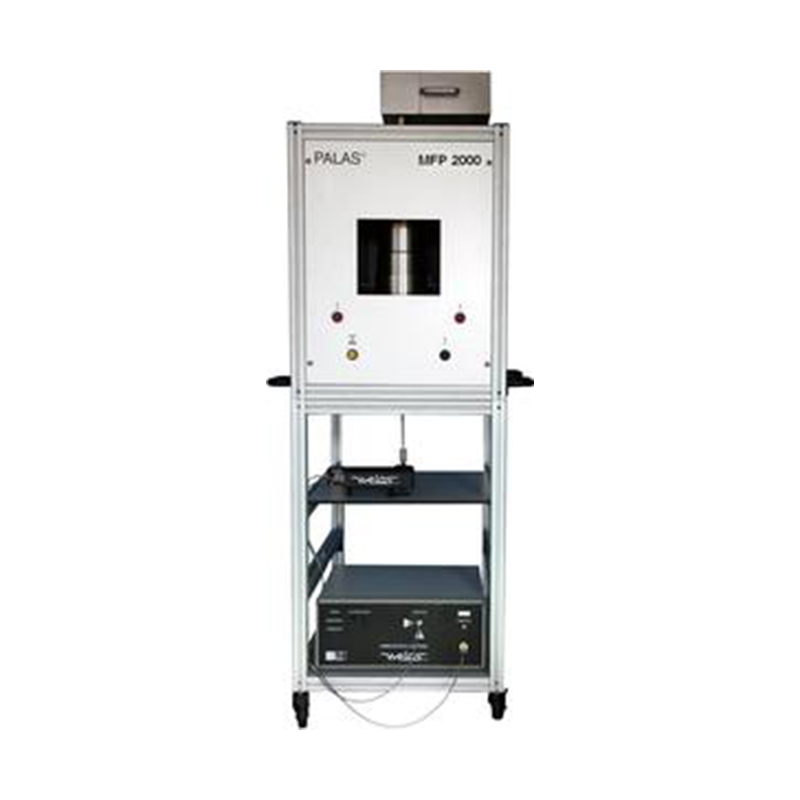
Fig. 1: MFP 2000
MFP filter test rigs from Palas® have already proved themselves many times over all around the world in practical applications in development and quality control.
The MFP filter test rig is a modular filter testing system for flat filter media and small mini-filters.
The MFP 2000 can be used to determine:
• pressure loss curve on the medium without a dust coating,
• fraction separation efficiency, or
• burden and fraction separation efficiency during application of the burden
within shortest times – reliably and therefore cost-effectively.
The aerosol generators are easy to interchange and coordinated with the overall system. As a result, filter tests can be performed quickly and easily with the different test aerosols.
With the aid of the light scattering spectrometer Promo® 2000, clear and reliable determination of the aerosol concentration and the particle size and therefore an accurate determination of the fraction separation efficiency can be ensured.
The largely automated setup of the test sequence together with the clearly defined individual components and the individually adjustable sequence programs of the filter test software FTControl combine to deliver the high reliability of our measurement results.
Our quality in detail

Fig. 2: MFP 2000
1. Variable aerosol generation Thanks to the use of different dispersers for dusts, KCl/NaCl, DEHS etc.; shortened measurement times are possible e.g. through increased dust concentration
2. Corona discharge (optional): Adjustable ion stream for different mass flows. Mixed air, adjustable for inflow speeds from 0.05 to 1 m/s. Optional: Transient inflow.
3. Mobile pneumatic filter holder for fast removal and loading of the test rig.
4. Light scattering spectrometer Promo® system for clear particle measurements in high concentrations of up to 1000 mg/m3 (SAE Fine) with integrated Windows test rig software.
5. Easy to operate even for untrained personnel thanks to the automated sequence programs for performance of the filter testing. The test rig can be controlled fully automatically.
Automation
The MFP 2000 has integrated mass flow controllers that it uses to control the volume flow; these can be automatically monitored and controlled via the FTControl filter test software. The integrated sensor data such as the volume flow and differential pressure at the filter are also recorded automatically during the filter test.
Measurement of the fraction separation efficiency

Fig. 3: Example: Comparison of fraction separation efficiencies
• Clear demonstration of the separation efficiency of your filter medium throughout the entire measurement range from 0.2 to 40 µm with the Promo® system
• With its maximum sensitivity, the particle measurement technology can highlight even fine differences in separation efficiency.
• Short measurement times of around 2 minutes per separation efficiency measurement thanks to optimized aerosol application
• Simple comparison of separation efficiency curves, calculation of mean values also possible
Sampling and layout
The strictly vertical layout of the MFP 2000 test system with just one sampling probe delivers clear measurements even for larger particles of up to 40 µm, as sedimentation losses can be ruled out. This enables reliable determination of the separation efficiency across the entire measurement range for all particle sizes.
Burden / hold time measurement and record of the pressure loss curve

Fig. 4: Example: Hold time measurement
• Performance of measurements of the fraction separation efficiency during dust application; pressure loss or measurement time can be pre-selected as the abort criterion
• Determination and representation of the pressure loss curve and retention curve in diagram and table form The representation of the particle diameters at 80% and 95% separation efficiency provides additional information.
• Comparison of the fraction separation efficiencies during the different burdening steps
• Shortening of the measurement times, e.g. through increased dust concentration
Aerosol generator of your choice
• RBG 1000
• AGK 2000 with drying length
• PLG 1000