
Long-term continuous monitoring of airborne particulate matter in remote plateau regions presents researchers with real-world challenges, including cumbersome equipment maintenance and difficulties in supplying consumables — while also placing high demands on instrument performance and field adaptability. The research team from Peking University’s College of Urban and Environmental Sciences adopted a combined solution featuring the Palas® AQ Guard Smart 2000 ultrafine particle number concentration monitor and the AQ Guard indoor air quality monitor, providing reliable technical support for ultrafine particle monitoring and air quality assessment studies in plateau regions.
The team of Associate Professor Shen Guofeng at Peking University’s College of Urban and Environmental Sciences focuses on regional environmental processes and effects of pollutants, with research interests spanning household energy structure, combustion emissions, pollution exposure, and health risk assessment. During long-term ultrafine particle sampling in plateau regions, the team encountered two major challenges with conventional SMPS (Scanning Mobility Particle Sizer) monitoring equipment: first, maintenance-intensive operation requiring regular replacement of isopropanol working fluid and frequent cleaning of classification columns and tubing, consuming substantial time and effort; second, the team’s plan to sample across multiple locations in Tibet was severely constrained by the difficulty of procuring isopropanol and other consumables in plateau regions, as well as transportation restrictions — significantly limiting field work flexibility.
In response to these challenges, the technical features of the Palas® AQ Guard Smart 2000 proved to be an excellent match for long-term continuous field monitoring requirements:
No Working Fluid, Low-Maintenance Long-Term Operation
Employing diffusion charging technology, the instrument requires no working fluid replenishment, supports 24/7 continuous stable operation, and substantially reduces maintenance frequency — solving the challenge of consumable supply in remote plateau regions for long-term monitoring.
Wide Measurement Range, Reliable Data
The instrument provides simple and accurate monitoring of ultrafine particles from 0.01 μm upward, simultaneously outputting key parameters including particle number concentration (PN), mean diameter, and lung-deposited surface area (LDSA). With a measurement range up to 10,000,000 particles/cm³, it delivers reliable data even in high-concentration environments. Built-in temperature, humidity, and air pressure sensors, with optional accessories such as sun shields and weather stations, further expand the instrument’s measurement capabilities.
Strong Adaptability for Various Monitoring Scenarios
Equipped with a heated inlet, the instrument operates stably across ambient temperatures from -20 to +40°C. Supporting multiple communication and data transmission options including LAN, Wi-Fi, and 4G, it ensures flexible data retrieval even in remote plateau regions, enabling high-temporal-resolution real-time monitoring that meets the demands of long-term sampling and data transmission.
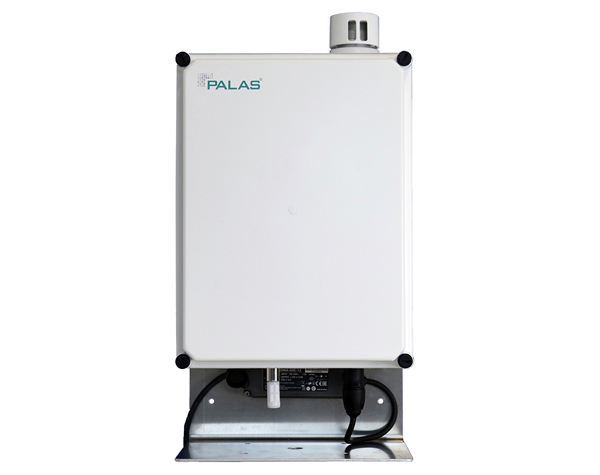
Palas® AQ Guard Smart 2000 Ultrafine Particle Number Concentration Monitor
Synergistic Monitoring for Expanded Research Dimensions
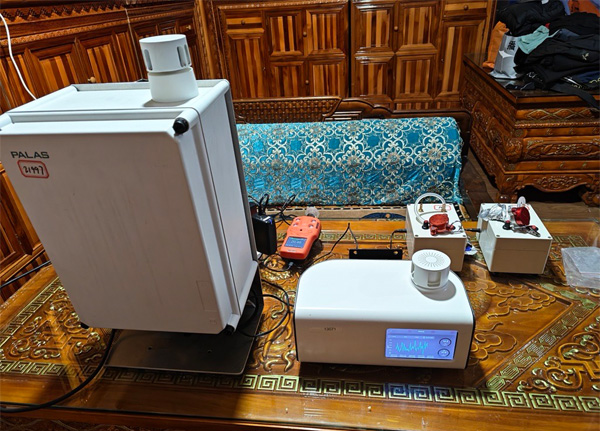
In this study, the team simultaneously deployed the AQ Guard indoor air quality monitor alongside the AQ Guard Smart 2000, creating functional complementarity. While the AQ Guard Smart 2000 specializes in precise counting and particle size distribution monitoring of ultrafine particles (from 0.01 μm upward), the AQ Guard delivers real-time measurements of PM₂.₅, temperature (T), relative humidity (rH), and atmospheric pressure (P), with the IAHP package further enabling outputs of PM₁, PM₄, PM₁₀, TSP, CO₂, particle number concentration (CN), and particle size distribution — while calculating air quality index and infection risk index based on advanced algorithms. Each instrument brings its own strengths to a coordinated approach, helping the team simultaneously acquire multi-dimensional data on ultrafine particle concentrations and indoor air quality within a unified research framework, providing richer and more comprehensive data support for systematically assessing the impact of household energy structure and combustion emissions on air quality and health risks.
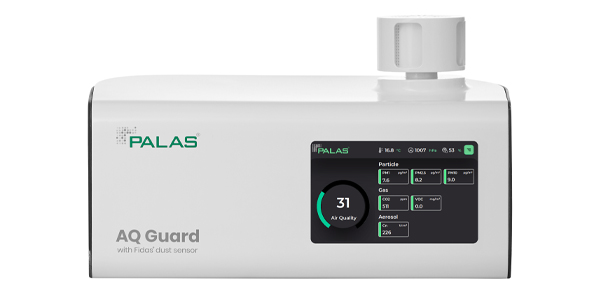
Palas® AQ Guard Indoor Air Quality Monitor
Dr. Xing Ran, a postdoctoral researcher at Peking University, noted that the team recommended and selected Palas based on three key factors: its deep expertise and strong reputation in the aerosol measurement field with assured data quality, product features well-suited to long-term monitoring needs in remote plateau regions — meeting the requirements for long-term indoor and outdoor air sampling in field conditions. Over the three-month monitoring period, the research team deployed two AQ Guard units and two AQ Guard Smart 2000 units, fully validating the synergistic performance and data reliability of both instruments in real-world scenarios.
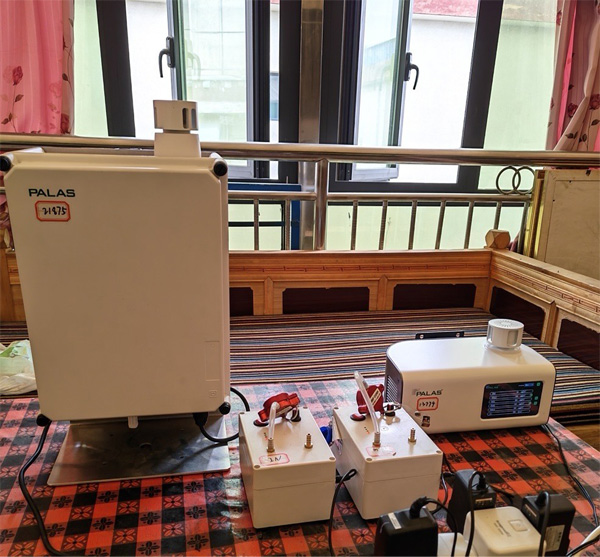
Throughout the collaboration, the Palas team demonstrated efficient work practices and strong problem-solving capabilities — from initial communications and equipment delivery to technical inquiries during usage, the team responded promptly and provided effective solutions. The combined solution of the two AQ Guard series instruments effectively supported three months of continuous monitoring in remote plateau regions, providing reliable technical means for long-term monitoring of ultrafine particles and indoor air quality, while laying a methodological foundation for subsequent research on household energy structure and health benefit assessment.
The Palas® AQ Guard Smart 2000 is suitable for applications including airports and seaports, industrial plants, traffic routes, urban air quality monitoring, and ultrafine particle formation and dispersion studies; the AQ Guard is applicable to schools, hospitals, hotels, office buildings, public transportation facilities, construction sites, residential buildings, and industrial production processes with bulk material handling for air quality monitoring and infection risk assessment. For more product information and application areas, please contact us:
Palas Instruments (Shanghai) Co., Ltd.
Email: info@palas.com.cn
Tel: 021-5785 0190
(Site photos courtesy of the College of Urban and Environmental Sciences, Peking University)